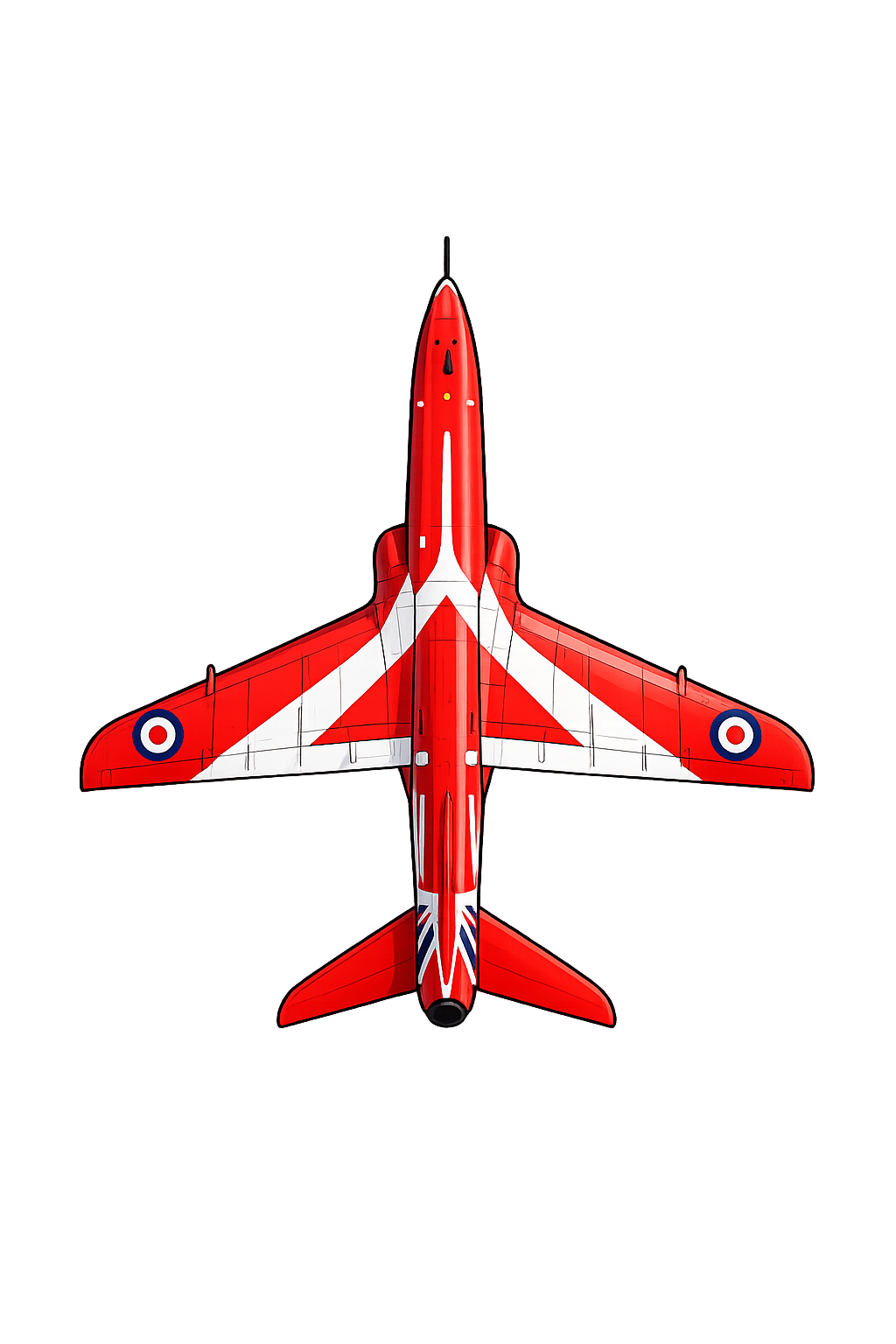
The Physics of Display Flying
What Red Arrows pilots actually experience — g-force, its effects on the human body, how they resist blackout, why jets are heard after they pass, and the science behind every display.
G-force is a measure of acceleration expressed as a multiple of the acceleration due to Earth's gravity — approximately 9.81 metres per second squared (m/s²). At rest, every person experiences 1g — their normal weight. When a pilot pulls into a tight turn or a looping manoeuvre, the aircraft accelerates rapidly and the effective force on their body multiplies.
In aerobatics, positive g (+Gz) pushes the pilot down into their seat — blood is forced away from the brain toward the lower body. Negative g (−Gz) is the reverse — blood rushes to the head — and is generally rarer and shorter in duration during display flying. It is the positive g loads that are most physiologically demanding during a Red Arrows display.
At 5g, a 75 kg pilot effectively weighs 375 kg. At 7g, that rises to 525 kg. Every organ, every litre of blood, every muscle in the body is subject to the same multiplication — which is why managing g-force is a core skill for every Red Arrows pilot.
The core problem under sustained positive g-force is blood flow to the brain. The human heart is designed to pump blood upward against 1g. As g-load increases, this becomes progressively harder — blood pools in the lower body and the brain begins to receive less oxygen. The effects follow a well-documented sequence:
Negative g produces the reverse: blood rushes to the head, overpressuring blood vessels in the eyes and brain — producing a characteristic red tinge to vision known as redout. It is less commonly encountered in display flying but carries its own risks.
Red Arrows pilots use two well-established countermeasures in combination — a g-suit and the Anti-G Straining Manoeuvre (AGSM). Neither eliminates the effects of high g-force, but together they significantly raise the threshold at which physiological impairment begins.
Together, an experienced pilot using both a g-suit and a well-executed AGSM can significantly extend their tolerance beyond the 4–6g threshold at which an untrained person would begin to lose vision. Red Arrows pilots train extensively to perform the AGSM consistently — poor technique has been a documented factor in g-LOC incidents in fast-jet aviation worldwide.
The Hawk T1 has a top speed of approximately Mach 0.84 — around 645 mph at altitude, or roughly 550 mph at lower display altitudes where air density is higher. During displays, the team typically flies between 300 and 450 knots (345–520 mph), adjusting speed for each manoeuvre. Some passes are deliberately slower to allow the crowd to appreciate the formation; others are at the upper end of the display envelope.
The most dramatic speed figures involve the Synchro Pair. When Reds 6 and 7 fly opposition passes — approaching each other head-on — their combined closing speed can exceed 800 mph. From the moment they appear on opposite sides of the display box, they may have only a few seconds before they pass each other. Timing, at that closing speed, is measured in fractions of a second.
One of the most striking experiences at a Red Arrows display is the moment a fast, low pass ends — the aircraft have already crossed the display line and are banking away before the roar of the engines reaches you. This isn't an illusion: it is a direct consequence of the speed at which sound travels.
Sound moves through dry air at around 343 metres per second (approximately 767 mph at 20°C). At a typical display speed of 400–450 mph, the Hawk T1 is covering ground at roughly 60% of the speed of sound — fast enough that by the time the sound generated at one point in the aircraft's path reaches your ears, the aircraft has already moved a significant distance further along its track. The faster the aircraft, and the further away it is when it generates the sound, the greater the delay before you hear it.
As an aircraft approaches, it is effectively chasing its own sound waves — compressing them in the direction of travel. This means sound waves arrive at your ears more frequently than they would from a stationary source: you hear a higher pitch.
As the aircraft passes and moves away, the opposite happens — sound waves are stretched out and arrive less frequently: you hear a lower pitch.
This is why the engine note of a fast jet drops sharply and noticeably the moment it passes overhead — the classic vrrROAR...roar of an airshow pass. The aircraft's speed determines how pronounced the effect is. The faster the jet, the more dramatic the pitch shift.
The Hawk T1 is transonic — capable of approaching but not exceeding the speed of sound in its display configuration. This means it does not produce a sonic boom at display speeds. A sonic boom only occurs when an aircraft exceeds the speed of sound, at which point it outruns all of its own sound waves simultaneously, creating a pressure shockwave. Displays over populated areas in the UK are flown well below that threshold.
In close formation, Red Arrows aircraft can fly with wingtip separations of as little as 6–8 feet. To put that in context, the Hawk T1 has a wingspan of 9.39 metres (30.8 feet). At 6-feet separation, the tip of one wing is closer to the adjacent aircraft than the length of a standard car.
At display speeds, covering the width of that gap would take a fraction of a second. Maintaining separation is not a matter of visual judgement alone — it requires each pilot to fly with absolute precision and to anticipate the subtle movements of the aircraft immediately adjacent to them. Pilots describe it as a constant, active process: there is no moment of inattention in close formation.
The physics of formation flying also mean that aircraft in close proximity experience aerodynamic effects from each other's wings — turbulence and wake. Outer formation positions require active correction to account for this. It is one of the reasons that positions in the formation carry different levels of complexity, and why newer pilots begin in the outer positions before progressing inward.
The iconic red, white and blue smoke trails are produced by injecting dyed diesel oil directly into the hot exhaust of the Hawk's jet engine. The heat vaporises the oil, which then condenses into a dense, visible smoke trail as it mixes with the cooler surrounding air.
Red and blue are produced by oil dyed with powder pigment. White uses plain, undyed oil. The smoke systems are housed in pods mounted under the aircraft fuselage, and pilots control them via a button in the cockpit.
Pilots also use the smoke as an active flying aid. At high speed and in tight formation, the trails left by adjacent aircraft give each pilot immediate visual information about the wind direction and strength at display altitude — helping them anticipate drift and maintain their position in the formation. The smoke is both spectacle and tool.
Display Sequence · The Aircraft · FAQ · Display Tracker