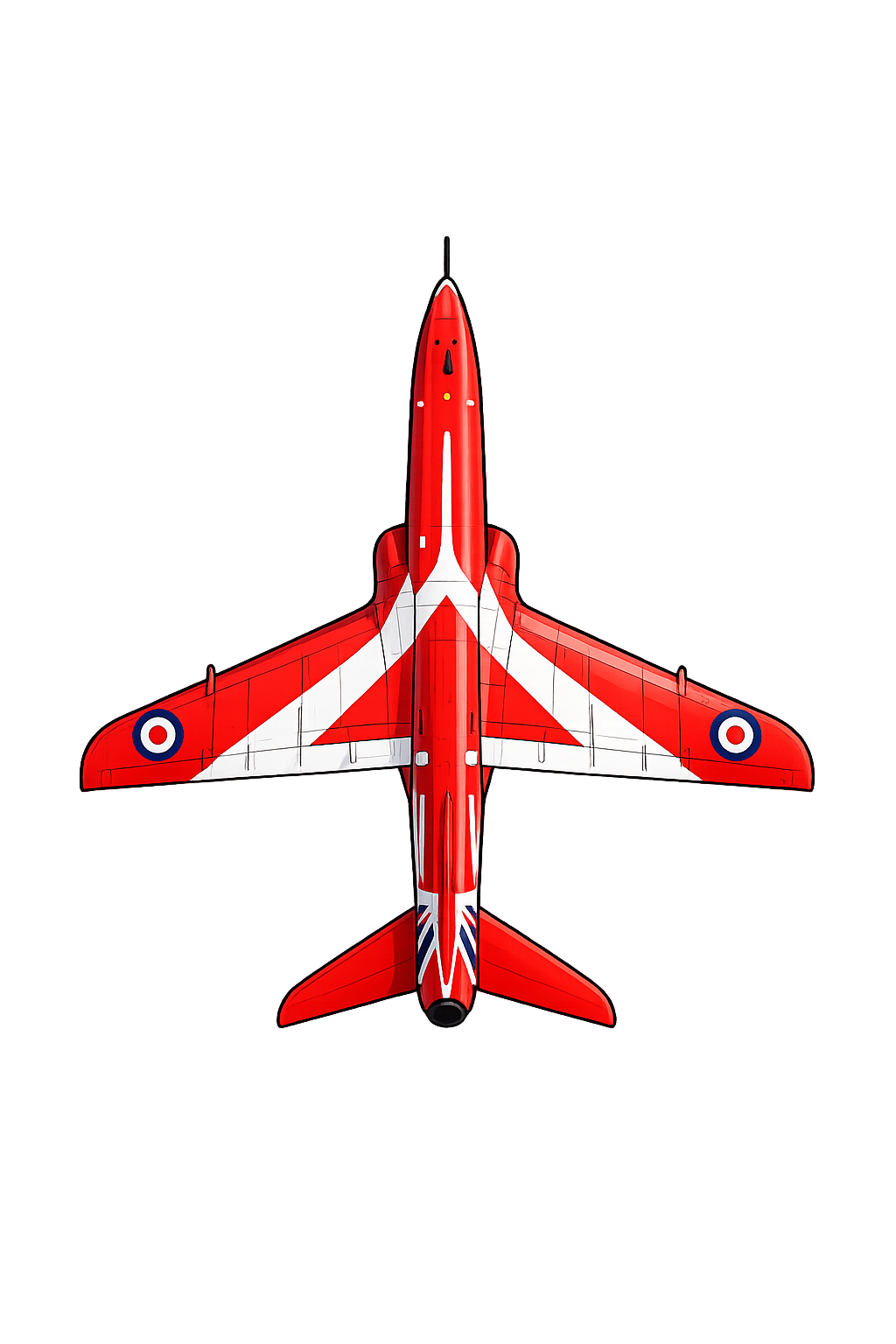
Red Arrows Aircraft

From the nimble Folland Gnat to the iconic BAE Hawk T1 — the aircraft that have defined six decades of world-class aerobatics.

BAE Systems Hawk T1
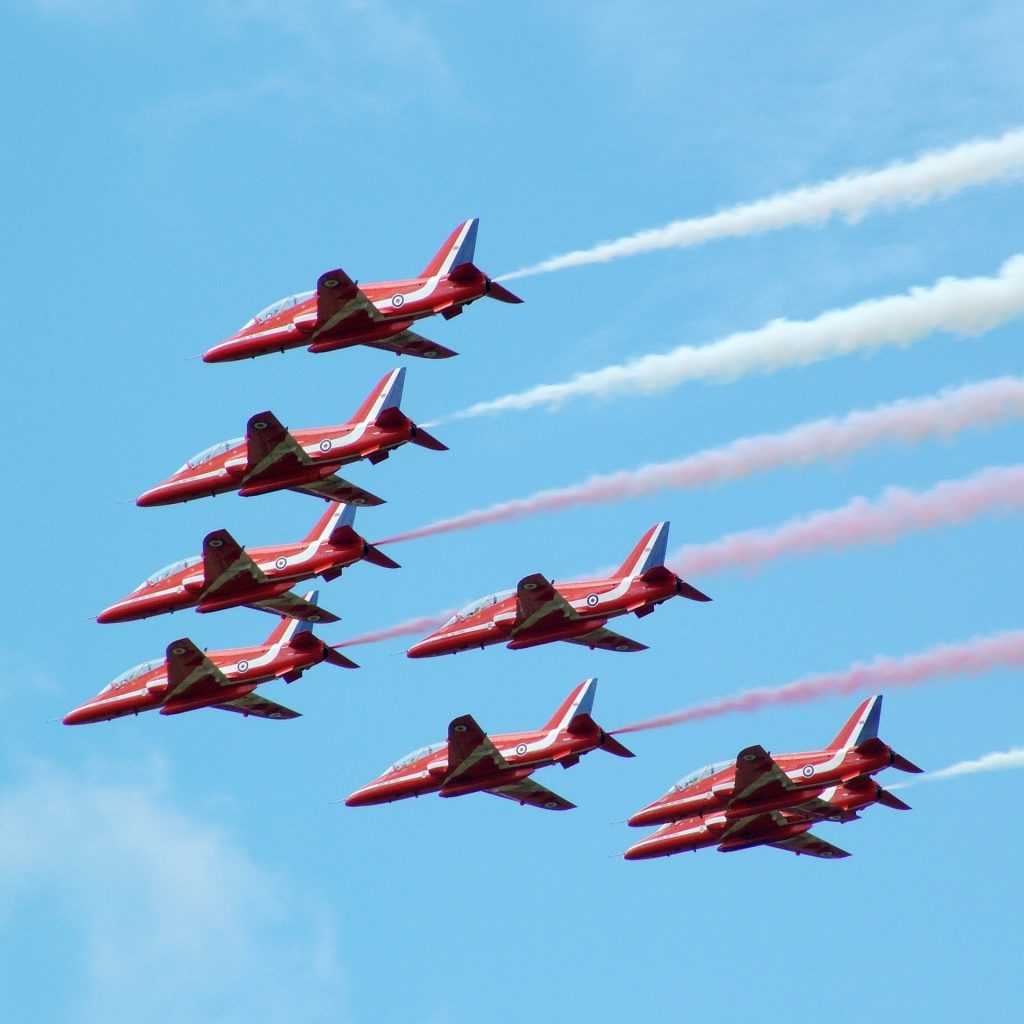
1979 – Present · Current aircraft
BAE Systems Hawk T1 Red Arrows

The Hawk T1 has been the Red Arrows' aircraft since 1979 — a highly capable advanced jet trainer designed and built in Britain. Originally developed by Hawker Siddeley (later BAE Systems), the Hawk has proven itself as a reliable, manoeuvrable aircraft perfectly suited to precision formation flying.

The team flies modified T1A variants, equipped with smoke pods under the fuselage to produce the iconic red, white and blue trails. Diesel dyed with powder pigment is injected into the jet exhaust at display altitudes, creating the vivid coloured trails seen at every show.

First Flight
1974
Engine
Rolls-Royce Adour turbofan
Max Speed
Mach 0.84 (645 mph)
Service Ceiling
~44,500 ft
Wingspan
9.39 m
Length
11.17 m
Seating
Tandem (2 crew)
In Service (RAF)
1976 – present

Despite the Hawk's age — most of the team's airframes date from the late 1970s — the aircraft continues to perform reliably. There have been ongoing discussions about a future replacement, but as of 2026 the Hawk remains the team's aircraft, with the fleet maintained to airworthy standard by the Circus ground crew at RAF Waddington.

Folland Gnat T.1
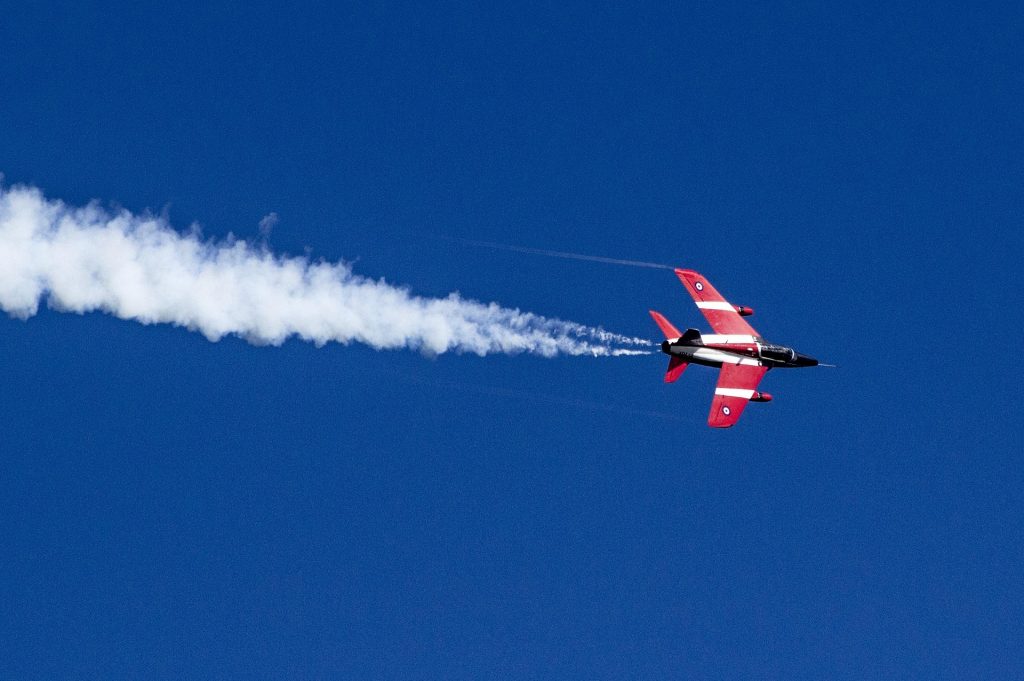
1965 – 1979 · Original aircraft
🛩
Folland Gnat T.1 Red Arrows

Before the Hawk, the Red Arrows flew the diminutive Folland Gnat T.1 from their formation in 1965 through to 1979. Despite its small size, the Gnat was an exceptionally agile aircraft perfectly suited to the tight formations that became the team's hallmark from the very start.

The Gnat's compact dimensions — a wingspan of just 7.3 metres — allowed the team to fly formations far tighter than most contemporary aircraft, establishing the Red Arrows' reputation for precision that endures today.

First Flight
1955
Engine
Bristol Siddeley Orpheus turbojet
Top Speed
Mach 0.91 (695 mph)
Wingspan
7.32 m
Length
9.68 m
Service Entry
1962 (RAF)
Red Arrows use
1965–1979
Display numbers
7 initially, 9 from 1968
Side-by-Side Comparison
Specification Folland Gnat T.1 BAE Hawk T1
Years with Red Arrows1965–19791979–present
EngineBristol Siddeley OrpheusRolls-Royce Adour
Max Speed695 mph (Mach 0.91)645 mph (Mach 0.84)
Wingspan7.32 m9.39 m
Length9.68 m11.17 m
SeatingTandem (2)Tandem (2)
Display aircraft7 (later 9)9
What Comes Next? — The Hawk Replacement

The BAE Systems Hawk T1 fleet is ageing — most airframes are over 40 years old and the Red Arrows are now the only RAF unit still flying the T1. Spare parts, including engines, are increasingly difficult to source. The team is expected to operate the Hawk T1 until around 2030, after which a replacement will be required.

The UK's 2025 Strategic Defence Review confirmed that both the Hawk T1 and T2 should be replaced with a cost-effective fast jet trainer, and a formal open competition is expected. Several aircraft have been publicly identified as candidates or have been evaluated. No selection has been made and no contract has been awarded.

Information below is based on publicly available manufacturer data and reporting. It reflects the competitive landscape as understood in mid-2026 — not an endorsement of any candidate or prediction of the outcome.

🇺🇸🇸🇪
Boeing–Saab T-7A Red Hawk
USA / Sweden
Engine
GE F404-GE-103 afterburning turbofan
Max Speed
Mach 1.2+ (supersonic)
Service Ceiling
50,000 ft+
G Limits
+8 g sustained
Wingspan
9.32 m (30 ft 7 in)
Length
14.3 m (46 ft 11 in)
Seating
Tandem (2)

Selected by the USAF in 2018 to replace the T-38 Talon (351 aircraft ordered). Features fly-by-wire controls, digital glass cockpit, and afterburner — significantly more capable than the Hawk T1. Boeing and BAE Systems have proposed UK final assembly at Warton as part of their bid. Programme has experienced development delays; USAF IOC now expected 2027. Evaluated as a candidate for the RAF requirement.

▶ Search YouTube for Boeing–Saab T-7A Red Hawk footage (external — content outside our control)
🇮🇹
Leonardo M-346 Master
Italy
Engine
2× Honeywell F124-GA-200 turbofan
Max Speed
Mach 0.89 (590 kt / 1,093 km/h) — reached Mach 1.15 in testing
Service Ceiling
45,000 ft
G Limits
+8 / −3 g
Wingspan
9.72 m
Length
11.49 m
Seating
Tandem (2)

Twin-engine advanced trainer in service with Italy, Israel, Singapore, Poland, Greece and Qatar. Its twin-engine layout is considered a safety advantage for training operations. Leonardo has a significant UK industrial presence. An armed light-attack variant (M-346FA) also exists. Considered a leading candidate for the RAF requirement.

▶ Search YouTube for Leonardo M-346 Master footage (external — content outside our control)
🇮🇹
Leonardo M-345
Italy
Engine
Williams FJ44-4M-34 turbofan
Max Speed
425 kt (787 km/h) at 20,000 ft
Service Ceiling
40,000 ft
G Limits
+7 / −3.5 g (limit); +4 g sustained
Wingspan
8.47 m
Length
9.85 m
Seating
Tandem (2)

Lighter and less expensive than the M-346, positioned as a high-efficiency basic-to-advanced trainer with lifecycle costs closer to turboprop types. In service with the Italian Air Force. An M-345 arrived at MoD Boscombe Down in mid-2025 for UK evaluation. Subsonic — would represent a step back in top-end performance compared to some candidates, but potentially well-suited to the Red Arrows role specifically.

▶ Search YouTube for Leonardo M-345 footage (external — content outside our control)
🇰🇷
KAI T-50 Golden Eagle
South Korea
Engine
GE F404-GE-102 afterburning turbofan
Max Speed
Mach 1.5 (supersonic)
Service Ceiling
48,000 ft
G Limits
+8 / −3 g
Wingspan
9.17 m
Length
13.14 m
Seating
Tandem (2)

Developed with Lockheed Martin assistance and broadly derived from F-16 geometry. In service with South Korea, Indonesia, Thailand, Iraq and the Philippines. An aerobatic display team — the Black Eagles — already operates a variant (T-50B), demonstrating the type's suitability for precision formation flying. Named as a candidate for the RAF requirement.

▶ Search YouTube for KAI T-50 Golden Eagle footage (external — content outside our control)
🇹🇷
TAI Hürjet
Turkey
Engine
GE F404-GE-102 afterburning turbofan
Max Speed
Mach 1.2+ (supersonic)
Service Ceiling
45,000 ft
G Limits
+8 / −3 g
Wingspan
9.0 m
Length
12.2 m
Seating
Tandem (2)

Newest entrant in the advanced trainer market, developed by Turkish Aerospace Industries. First flew in 2023. Not yet in service with any air force. Has been named among the candidates being considered for the RAF requirement. As a new programme, it carries more development risk than established types.

▶ Search YouTube for TAI Hürjet footage (external — content outside our control)
No decision has been made. The above reflects publicly reported candidates as of mid-2026. A formal RAF competition is expected but no contract has been awarded and no selection announced. Specifications are from publicly available manufacturer and official sources and are provided for general interest only. Until a replacement is selected and funded, the long-term future of the team beyond 2030 remains subject to wider RAF and Ministry of Defence decisions.