Red Arrows FAQ
Everything you want to know about the RAF Red Arrows — aircraft, pilots, displays, history and more.
✈ Aircraft & Technical
👨✈️ Pilots & Careers
📻 Frequencies
🏆 History
General
When is the Red Arrows display season? ▼
The display season typically runs from late April or early May through to mid-September each year. The team performs Public Displays at airshows and events once they have received their Public Display Authority (PDA), usually from late May. Pre-season work-up flying begins in January at RAF Akrotiri in Cyprus, where the team trains in the more reliable Mediterranean weather before returning to the UK.
How many aircraft does the Red Arrows use? ▼
The Red Arrows fly up to nine BAE Systems Hawk T1 jets. In 2026, the standard public display formation is seven aircraft (Reds 1–7), following an announcement by Air Vice-Marshal Mark Jackson that reducing the formation size would help manage the final years of service life of the ageing Hawk T1 fleet. For selected national and state occasions — such as the King's official birthday — all nine aircraft fly together. The team also maintains spare aircraft to cover maintenance requirements. A formal replacement aircraft programme has not yet been announced.
Why are there only seven Red Arrows aircraft now, not nine? ▼
From the 2026 season the Red Arrows display in a seven-aircraft formation for standard airshow displays, with Reds 8 and 9 joining only for selected national flypasts. The change was announced by Air Vice-Marshal Mark Jackson to help better manage the final years of service for the Hawk T1 fleet. The aircraft are now the only Hawk T1s still flying with the RAF and spare parts, including engines, are becoming harder to source. Flying nine jets for every display would place additional strain on airframes and reduce certainty for the season. The adjusted formation gives greater reliability and a longer operational life for the aircraft until a successor is selected.
How many pilots are in the Red Arrows? ▼
The team has nine display pilots (Reds 1–9), led by the Officer Commanding (OC RAFAT), who holds the rank of Wing Commander. There is also a Red 10 — a pilot who acts as the team's safety supervisor and ground commentator at displays. The team is supported by approximately 150 personnel in total, including engineers, ground crew and logistics staff.
Who leads the Red Arrows? ▼
The Red Arrows are commanded by the Officer Commanding RAFAT (OC RAFAT), who holds the rank of Wing Commander. In January 2026, Wing Commander Sasha Nash took command, becoming the first woman to hold this role in the team's history. She previously flew the Tornado GR4 on frontline operations and served as Chief of Staff in the Display Wing Headquarters at RAF Waddington alongside the Battle of Britain Memorial Flight. She succeeded Wing Commander Adam Collins, who completed a three-year tour.
How long has the Red Arrows been flying? ▼
The Red Arrows were formed in 1964 and gave their first official display on 6 May 1965 at Fairford, making them one of the world's longest-running aerobatic display teams with over 60 years of continuous performances.
Where are the Red Arrows based? ▼
After decades at RAF Scampton, the Red Arrows are now based at RAF Waddington in Lincolnshire. The move followed the closure of Scampton and marked a new chapter for the team, while keeping the Red Arrows in the county that has long been synonymous with their operations and training.
How many displays do the Red Arrows do each year? ▼
The number varies year to year. In 2026 the team has 23 confirmed displays and flypasts in the UK, alongside overseas commitments. In a busy season the total — including international events and state flypasts — can exceed 50 appearances. The exact number depends on the schedule, aircraft availability, and any additional commitments from the RAF.
Do the Red Arrows fly in winter? ▼
The team does not perform public displays in winter, but training flying is intensive from January through to spring. Each new season begins with work-up flying in Cyprus (Exercise Springhawk) under the more predictable Mediterranean weather, before the team returns to the UK to complete training and work towards their Public Display Authority. New pilots joining the team train through the winter before flying in formation with the rest of the team.
Aircraft & Technical
What aircraft do the Red Arrows fly? ▼
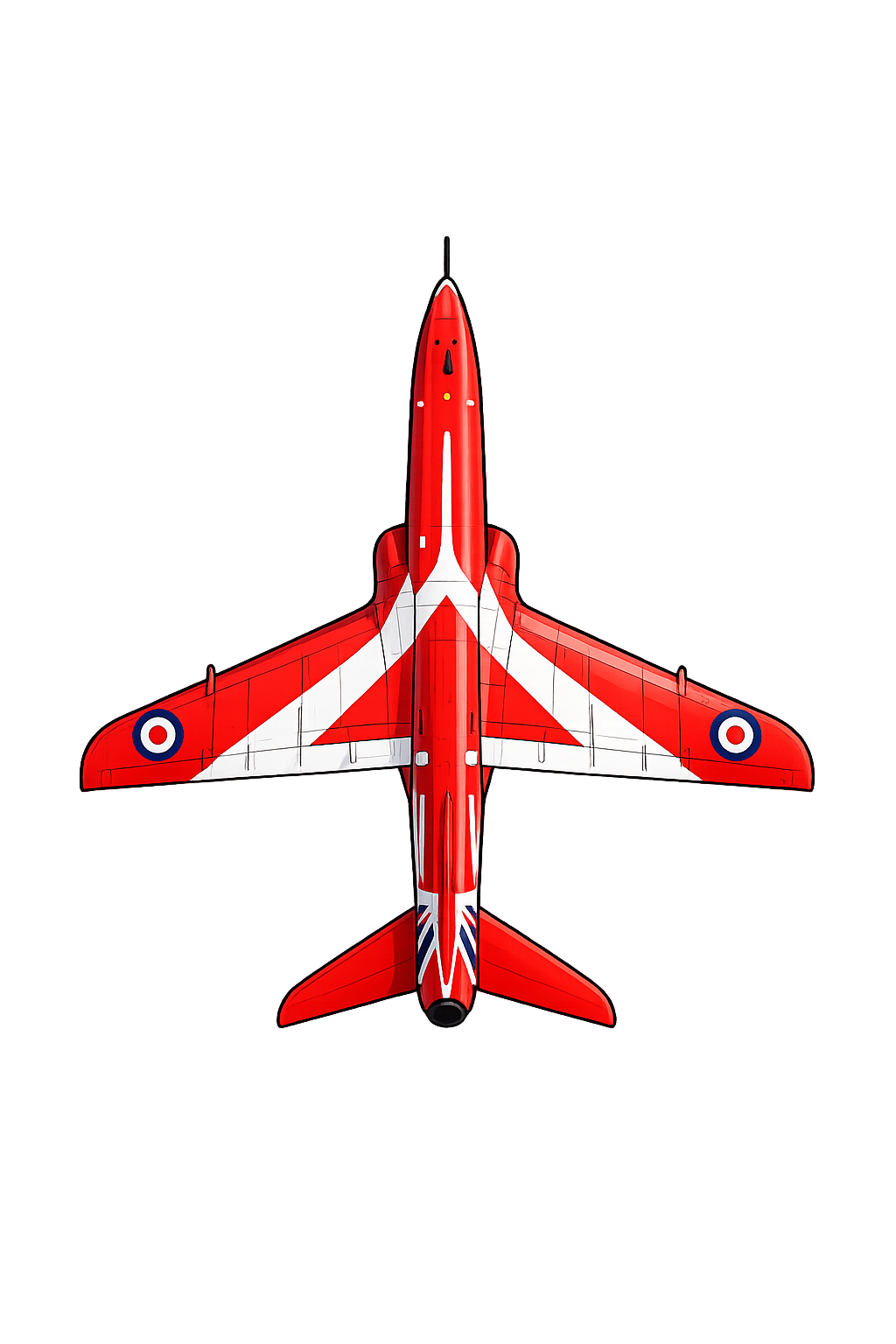
The team flies the BAE Systems Hawk T1, a twin-seat jet trainer first introduced in 1976. The Hawk has a top speed of around 620 mph (Mach 0.84) and is powered by a single Rolls-Royce/Turbomeca Adour turbofan engine. The Red Arrows' aircraft are modified with smoke systems — oil injected into the exhaust produces red, white and blue coloured smoke. The Red Arrows are now the only RAF unit still operating the Hawk T1; RAF training squadrons moved on to the Hawk T2 some years ago.
How do they make the red, white and blue smoke? ▼
The coloured smoke is produced by injecting dyed oil (diesel-based fluid) into the hot exhaust pipe. Red and blue are dyed; white smoke is produced using plain oil. The smoke systems are pod-mounted under the aircraft and pilots control them via a button in the cockpit.
How close do the Red Arrows fly to each other? ▼
In close formation the aircraft wingtips can be as little as 6–8 feet apart. The pilots train extensively to maintain these separations, which require absolute concentration and total trust in their colleagues.
How fast do the Red Arrows fly during displays? ▼
Display speeds vary by manoeuvre but are typically between 300 and 450 knots (345–520 mph). The Synchro Pair can reach higher speeds during their crossing and opposition passes.
What is the Synchro Pair? ▼
The Synchro Pair are Reds 6 and 7 — the two pilots who perform the opposition and crossing manoeuvres in the second half of a Red Arrows display. While the rest of the formation flies together, the Synchro Pair split away and pass each other at high speed, often head-on and at low level. Their manoeuvres require exceptional precision: any error in timing or positioning at the speeds involved leaves no margin. Becoming a Synchro pilot is typically a third-year role, requiring the experience built across the first two seasons.
Will the Red Arrows get new aircraft? ▼
The Hawk T1 is expected to remain in service with the Red Arrows until approximately 2030, supported by spare airframes and parts management. A formal replacement programme has not been announced. Any future aircraft decision for the Red Arrows will be closely linked to wider RAF training requirements. The collapse of UK start-up Aeralis — which had proposed a modular jet trainer — removed one domestic option from consideration. The Red Arrows' role as a showcase for British aerospace adds complexity to any future procurement decision.
Pilots & Careers
How do you become a Red Arrows pilot? ▼
To fly with the Red Arrows you must be a serving RAF fast jet pilot with substantial fast-jet experience — typically including a tour on a front-line squadron (in recent years, predominantly on the Typhoon). Pilots apply voluntarily and are selected through a rigorous assessment process including flying evaluations, peer assessment, and interviews. There is no direct civilian application route; it is exclusively open to serving RAF officers.
How long do Red Arrows pilots serve with the team? ▼
Display pilots serve for three years. In their first year they typically fly in the outer positions of the formation (Reds 8 and 9 in 2026) as they build experience and trust within the team. By year two they move into more prominent roles, and in year three experienced pilots may become the Synchro Pair (Reds 6 and 7) or other senior positions. The Officer Commanding (OC RAFAT) serves a separate three-year tour in command.
What is the Red Arrows pilot salary? ▼
Red Arrows pilots are serving RAF officers and are paid on standard RAF officer pay scales — there is no display bonus or premium for the role. Most display pilots hold the rank of Flight Lieutenant, with basic pay starting from around £50,500 and rising through incremental steps with experience. The Officer Commanding holds the rank of Wing Commander, with pay in line with that grade. In addition to basic pay, aircrew receive a flying pay supplement, and service benefits include a military pension (with no personal contribution required), subsidised accommodation, and healthcare. Pilots do not join the Red Arrows for financial reasons — the role is sought for its prestige, challenge, and unique experience.
What rank are Red Arrows pilots? ▼
The majority of display pilots hold the rank of Flight Lieutenant. The Officer Commanding (OC RAFAT) holds the rank of Wing Commander and has overall command of the approximately 150-strong team, covering all aspects from safety and engineering to displays and engagement. Red 10, the team's safety supervisor and commentator, is typically a more experienced pilot who has completed a previous tour with the team.
How many hours do Red Arrows pilots fly each year? ▼
During the winter training season (January–April) pilots fly multiple sorties per day, building up progressively from pairs to the full formation. The pace of training is intensive: the team must earn their Public Display Authority before the season opens. Over a full year including the display season, pilots log substantial hours on the Hawk alone.
Do Red Arrows pilots do other jobs? ▼
Red Arrows pilots are serving Royal Air Force officers on a fixed-term posting — the role is not a permanent career in itself. After completing their tour, pilots return to other RAF duties, which may include frontline flying, instructional roles, staff appointments, or further specialist postings. Many Red Arrows alumni have gone on to senior positions within the RAF, and some have transitioned to commercial aviation.
Can civilians apply to fly with the Red Arrows? ▼
No. The Red Arrows are an RAF operational unit and all display pilots must be serving RAF fast-jet officers. There is no civilian or direct-entry route into the team. To fly with the Red Arrows you must first complete a full RAF flying career, including frontline fast-jet experience, before being eligible to apply.
Displays & Spectating
How far in advance are Red Arrows displays announced? ▼
Display locations are usually announced by event organisers several months in advance, though exact timings may not be confirmed until closer to the date. NOTAM data — which this site uses — is typically published a few weeks to a few days before the event. Always check official event websites for the latest confirmed timings.
Can the Red Arrows be cancelled at short notice? ▼
Yes. The Red Arrows are an operational RAF asset and displays can be cancelled at any time due to weather, aircraft unserviceability, or operational RAF requirements. Fog, low cloud, or strong crosswinds at a display site can cause last-minute cancellations even on the day. Always check event social media on the morning of a display.
What happens if the weather is bad on display day? ▼
The Red Arrows have three display categories depending on visibility and cloud base: Full (clear conditions), Rolling (reduced visibility or lower cloud — a modified flat routine) and Flat (low cloud — manoeuvres kept below the cloud base with no loops). In very poor conditions — heavy rain, fog or strong crosswinds beyond operating limits — the display may be cancelled entirely. The decision rests with the team's leader on the day in consultation with the event and the RAF. A display going ahead in poor conditions does not mean it will look the same as in sunshine.
Where is the best place to watch the Red Arrows? ▼
The most reliable views are from the official display lines at major airshows — events such as RIAT (Fairford), Farnborough, Eastbourne Airshow, Blackpool Air Show, and Sunderland International Airshow all offer excellent vantage points with confirmed timings. For flypasts at non-airshow events, positioning yourself along the announced flypast track gives the best chance of a sighting. The Tracker on this site shows planned transit routes and display locations — but note that transit routes are not displays and sightings are never guaranteed.
Is there a ticket to see the Red Arrows? ▼
The Red Arrows do not sell tickets themselves. Displays at airshows are included as part of the event (which may have its own admission charge). Many flypasts at non-airshow events — such as coastal air displays or state occasions — are free to view from public areas. There is no Red Arrows ticketing system; all access is through the events at which they are appearing.
What is the minimum height the Red Arrows can display? ▼
The Red Arrows are authorised to perform displays down to 100 feet above ground level in their close formation sequences over land, and to lower heights during certain manoeuvres performed over the sea. Display minima are set by the Civil Aviation Authority (CAA) and are strictly observed.
How do I request the Red Arrows for my event? ▼
Display requests are handled through the official RAF website. Applications for the following year typically open in June and close in December. Events must be of significant public interest — private events such as weddings or corporate functions are not considered. There is no charge for the display itself, but organisers must meet requirements around airspace, crowd safety, and logistics.
Can I meet the Red Arrows pilots at an airshow? ▼
The team regularly attends ground engagements at airshows, and pilots and ground crew are often present at the Red Arrows stand or the RAF Experience area at events. Signings and meet-and-greets are at the discretion of individual events and the team's schedule on the day — there is no guaranteed access. Checking the event programme in advance is the best way to find out whether the team will be on the ground.
Tracking & This Site
Is this a live tracker? ▼
No. This site is not a live tracker and does not show real-time aircraft positions. It brings together display schedules, NOTAM-derived route information, and public updates to help enthusiasts understand when the Red Arrows may be operating nearby. For live aircraft positions once airborne, use FlightRadar24 or ADS-B Exchange.
What is a NOTAM? ▼
NOTAM stands for Notice to Airmen — an official notice published by aviation authorities to inform pilots and air traffic control of information essential to flight safety. NOTAMs cover temporary airspace restrictions, air displays, military activity and similar events. When the Red Arrows are scheduled to operate, NOTAMs are published to alert other aircraft in the area. This site uses NOTAM data to give advance awareness of when and roughly where the team may be flying — but the full content of NOTAMs is not reproduced here.
What is the difference between a transit and a display? ▼
A display is a ticketed or public aerobatic performance at a specific location — with smoke, low-level manoeuvres, and the full routine. A transit is simply the team flying from A to B between locations. During a transit the aircraft may be at altitude, on a different route than published, and will not perform any display manoeuvres. There is no smoke, no low-level pass, and no guarantee of any visual sighting. The tracker on this site shows transit routes as a loose guide to routing only — they are not viewing opportunities in the same way as a display.
Why did the Red Arrows not appear where expected? ▼
Routes and timings can change at any point — sometimes while the aircraft are already airborne — due to weather, operational requirements, or ATC. Nothing shown on this site is guaranteed. Transit routes in particular are indicative only and may differ entirely from published information. This site is updated in good faith from public sources but cannot reflect real-time changes. If you did not see the team, that is entirely normal — always verify with official event sources before making travel plans.
Radio & Frequencies
What radio frequencies do the Red Arrows use? ▼
The Red Arrows use standard military VHF/UHF aviation frequencies. The primary display frequency is typically 127.350 MHz (a commonly used UK military display frequency), though this can vary by event and location. Approach and en-route communications use standard ATC frequencies for the airspace they are operating in.
Can I listen to the Red Arrows on a radio scanner? ▼
In the UK, the legality of listening to aircraft communications on a scanner is subject to the provisions of the Wireless Telegraphy Act 2006 and other applicable regulations, and users should ensure compliance with current guidance issued by Ofcom. Aviation band scanners covering 118–137 MHz (VHF civil) and 225–400 MHz (UHF military) are capable of receiving aircraft communications when transmissions are within range, including those from the Red Arrows during air displays and transit flights. Popular frequencies associated with airshows may include 127.350 MHz, 122.100 MHz and local approach frequencies for the event aerodrome. Users are responsible for ensuring that any monitoring, recording, disclosure or use of received communications complies with applicable law.
Do the Red Arrows use encrypted communications? ▼
For display purposes the Red Arrows generally use unencrypted VHF/UHF communications, which is why they can be heard on a standard aviation scanner at airshows.
History & Facts
What is the history of the Red Arrows? ▼
The team was formed in 1964 as part of the Central Flying School, initially based at RAF Little Rissington. They first flew with seven Folland Gnat trainers before expanding to nine aircraft in 1968. The team transitioned to the BAE Systems Hawk T1 in 1979, which they continue to fly today. Over their history they have performed nearly 5,000 displays in more than 57 countries. They are widely regarded as one of the world's most experienced and most-watched aerobatic display teams.
Why are they called the Red Arrows? ▼
The name reflects both the team's red aircraft and the arrow-like formations they fly. The original Gnat trainers were painted red and white, and the name was established early in the team's history. The Hawk aircraft used today carry the same distinctive red livery.
Have any Red Arrows pilots died? ▼
Yes. Over the team's history, several pilots and crew members have been killed in accidents. Notable incidents include the deaths of Red 1 Squadron Leader Stephen Randle in 1988 (a mid-air collision during training), Flight Lieutenant Jon Egging in 2011 following an accident after a display at Bournemouth, and Flight Lieutenant Sean Cunningham in 2011 when his ejector seat fired on the ground at RAF Scampton. The team has also suffered non-fatal accidents. Each loss has led to detailed investigations and safety improvements. The Red Arrows take their safety responsibilities extremely seriously, and display flying is conducted within strict regulatory limits.
Have the Red Arrows ever flown abroad? ▼
Yes — the Red Arrows have performed displays in over 57 countries across Europe, the Middle East, Asia, North America and beyond. Notable overseas tours include the USA, Canada, Australia, Japan, and Gulf States, among many others. In 2024 the team undertook a high-profile tour of Canada. A tour of the United States was planned as part of the 2026 international season. Overseas tours are a significant part of the RAF's broader engagement and represent the UK internationally.
Why are they called the Red Arrows? ▼
The name reflects both the team's red aircraft and the arrow-like formations they fly. The original Gnat trainers were painted red and white, and the name was established early in the team's history. The Hawk aircraft used today carry the same distinctive red livery.
What is the Red Arrows' environmental impact? ▼
The Hawk T1 burns approximately 1,500–2,000 litres of Jet A-1 per hour in typical operation. The RAF has committed to net-zero military flying by 2050 and is exploring sustainable aviation fuels (SAF). The Red Arrows have participated in SAF trials as part of this commitment.
Information is provided in good faith based on publicly available sources. This is an unofficial fan site with no affiliation to the RAF or Ministry of Defence.